Dog Training Client Communication: The Answer You Gave at 10pm
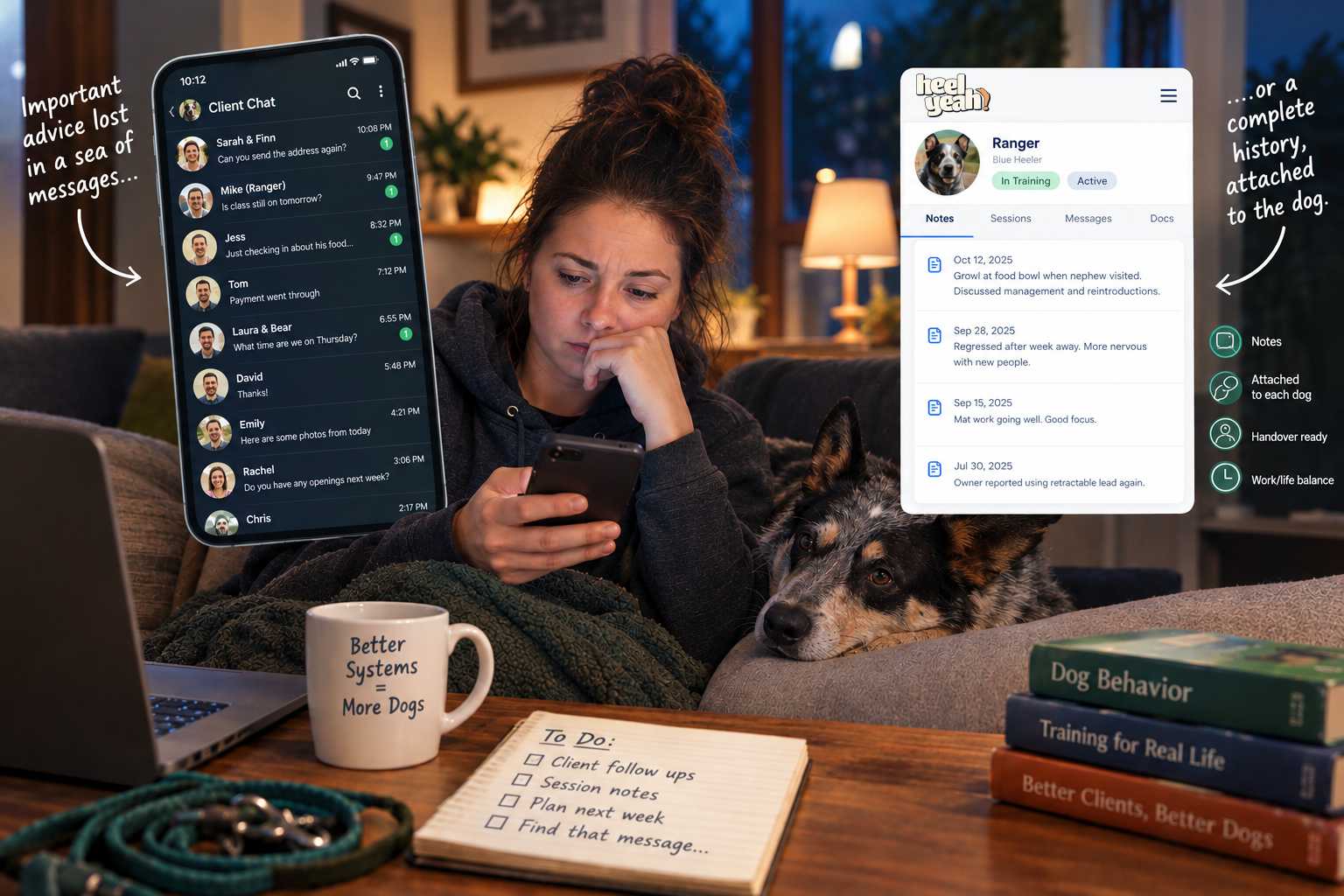
Ten past ten on a Sunday night. Your phone goes, and it is the owner of the eighteen month old cattle dog you saw on Thursday. Her nephew was over this afternoon, the dog stiffened and gave a low growl when he went for the food bowl, and she wants to know whether she should be worried.
You are on the sofa. You answer properly, because it is a good question and a growl over a bowl is worth taking seriously. You type out four paragraphs about what a growl is actually telling her, what to do this week, and what not to do, which is punish it.
Six weeks later the dog does it again with a different visitor, and you go looking for what you told her. It is somewhere in a thread with eleven hundred messages, above the photos of the new crate and below the bit where you rearranged a session. You never find it. Neither does the trainer who covers for you in August, because she was never going to.
Your personal phone is not a business system
Almost every trainer runs client communication out of the same phone they use to talk to their mother. It happens by default, not by decision, and it holds up for a surprisingly long time.
What it costs you only shows up later. Nothing in there is searchable in any useful way. Nothing is attached to the dog it is about. Nothing can be handed to anyone else. And there is no line at all between the hours you work and the hours you do not, which is why you answered at ten past ten on a Sunday and why you will do it again next week.
The messages themselves are not the problem. The advice you gave was good. The problem is that the most valuable record of a dog's history is sitting in a consumer chat app that was never designed to hold it.
Half your conversation is a clinical record
Strip out the scheduling chatter and what is left in a client thread is a behavioral history. The growl over the food bowl. The week they went away and the dog regressed. The photo of the mat work going well. The message where they admitted they had gone back to the retractable lead.
That is the same material you would put in a session note, and it deserves the same treatment: filed against the dog, kept for as long as you work with them, and findable in seconds. When an owner asks in October what you said in June, the answer should take ten seconds to produce, not an evening of scrolling.
Search is the whole difference. Being able to type "growl" and see every time it came up, with the dates, turns a chat log into something you can actually practise from. A phone thread gives you a scroll bar and good luck.
The thread where a client tells you what the dog did this week is not small talk. It is the only continuous record you have between sessions.
Most of those messages are questions the software should have answered
Read back a month of your client messages and a large share of them are not about training at all. What time are we on Thursday. Did you get my payment. Is class still on tomorrow. Where are we meeting. How many sessions have I got left.
Every one of those is a question you are being asked because the answer was not available anywhere else. They are cheap to answer individually and expensive in aggregate, because they arrive one at a time across a whole week and each one costs you the thread you were on.
The fix is not to answer faster. It is that a booking sends its own confirmation, a change sends its own notice, a reminder goes out the day before, and the balance on a package is visible to the person who bought it. Once the client can look it up, they mostly do, and your inbox quietly becomes the place where the real questions live.
Let people choose how they hear from you
Trainers tend to pick one channel and push everything down it. Some clients read every email. Some have not opened one since 2019 and will only ever see a text.
Letting each person choose is not a nicety, it is the difference between a reminder that works and one that does not. Email for the ones who read email, text for the ones who do not, and a setting per person rather than a policy for everybody.
Two things then have to be handled for you. Messages should not go out at three in the morning because that is when the cron ran, so quiet hours need to hold them until a reasonable time. And if you are texting, someone has to deal properly with a client who replies STOP: that is a legal obligation, not a preference, and it needs to work whether or not you are awake to see it.
Telling forty people one thing
The other communication job is one to many, and it is the one that gets done worst. The class on Wednesday is cancelled because the field is under water, and you need eighteen households to know in the next twenty minutes.
What usually happens is a group text, which is a small disaster: everyone gets everyone's number, the first person to reply "ok thanks" triggers seventeen notifications, and two people who changed their number never hear anything. What you want is one message written once, delivered to each person separately on the channel they use, with a record that it went.
That applies well beyond weather. A class roster that needs to know the venue moved, or every client who should hear that you are away the week after next. Written once, sent properly, no group thread.
The part that matters the day you are not there
All of this stays theoretical until the first time somebody else has to pick up one of your clients. You break an ankle, or you take a week off, or you bring on a second trainer.
If the history lives in your phone, it does not transfer. The person covering opens a client record with a name, a breed and a session list, and walks into a house knowing none of the context that would let them not make things worse. Everything that mattered is in a thread on a device in your pocket.
When the conversation lives with the client record instead, handover is nothing. They read the last two months in five minutes and arrive knowing about the food bowl. That is also the moment you stop being the only person who can serve your own clients, which is the actual ceiling on a training business.
From a trainer using HeelYeah
“It’s not just making the admin easier for me. It’s making it easier for my clients to actually follow their program. They know what they’re working on. They can find the resources I’ve given them. They know how many sessions they have left.”
You are allowed to have evenings
The last thing worth saying is the one trainers find hardest, and no software solves it on its own.
A separate channel for work gives you something a personal number never can, which is the ability to close it. The Sunday message still arrives, it still gets a good answer, and it gets one on Monday morning. Clients adjust to that far more easily than most trainers expect, because what they actually want is a reliable answer rather than an instant one. The people who answer everything within minutes are not getting better results. They are just getting fewer evenings.
Get the conversation off your personal phone and onto the client record. Let the routine questions answer themselves. Let each person pick how they hear from you. Then the messages you do get are the ones worth your attention, and the growl over the food bowl is still there in October when you need it.