How to Write Dog Training Session Notes That Actually Help
Every trainer keeps some kind of notes. The question is whether those notes are still useful three sessions later, when the dog in front of you is one of fifteen you have seen this week and you are trying to remember what actually worked last time.
Good session notes are not about writing more. They are about writing the few things that let you pick up exactly where you left off, show an owner real progress, and hand a dog off to another trainer without losing the thread. Most notes fail at this not because the trainer was lazy, but because there was no structure telling them what to capture.
Why most session notes fall short
The typical note is a paragraph written from memory at the end of a long day: "Good session, worked on recall, Bella is coming along." A week later that sentence tells you almost nothing. Was recall on leash or off? At what distance? What distractions were present? Did something set her back?
Three problems show up again and again:
- They are written too late. Detail fades fast. A note written the next morning is a summary of a summary, and the specific, useful bits are the first to go.
- They mix everything together. Behavior, medical flags, training progress, and how the dog handled other dogs all end up in one blob, so nothing is easy to find when you need it.
- They are not built to be read again. A note that only makes sense to the person who wrote it, on the day they wrote it, is a diary entry, not a record.
All three are fixable with a bit of structure, and none of them require writing a novel after each session.
Capture the note while it is fresh
The single biggest improvement most trainers can make is writing the note during or immediately after the session, not hours later. The details that matter, the exact distance a dog held a stay, the moment reactivity kicked in, the thing that finally clicked, are sharp for a few minutes and gone by evening.
This does not have to be polished. A few specific lines captured in the moment beat a tidy paragraph reconstructed from memory. If you can jot it from your phone right there in the yard or the training space, you will capture the version that is actually worth keeping.
Separate the note by type
A dog's session touches several different things at once, and lumping them together is what makes notes hard to use later. It helps to keep distinct categories:
- Behavior. What you observed: thresholds, triggers, body language, what changed from last time.
- Training. What you worked on and the actual result: the skill, the criteria, where the dog is now.
- Medical. Anything physical worth flagging: a limp, sensitivity to handling, something the owner should watch.
- Social. How the dog handled other dogs or people, which matters for group classes and daycare.
- General. Logistics, owner conversations, and everything that does not fit the others.
When notes are categorized, a question like "has this dog ever shown resource guarding?" takes seconds to answer instead of a scroll through months of mixed paragraphs. It also means a medical flag does not get buried inside a training note where the next person misses it.
Use tags for the patterns that repeat
Some things come up over and over across a dog's whole history: threshold distance, frustration, reactivity to bikes, a particular fear. Free text is fine for describing a single session, but it is bad at showing a trend, because you cannot search a feeling written five different ways.
Consistent behavior tags fix this. If you tag the relevant sessions with the same short label every time, you can look back and see whether a pattern is improving, holding steady, or getting worse, rather than relying on the impression you happen to have that day. The tag is what turns a pile of individual notes into a story you can actually read.
Add the evidence, not just the words
A short video of a dog holding a stay at a distance she could not manage two weeks ago is worth more than any sentence you could write about it. Photos and video attached to the note do two things: they make progress undeniable when you show an owner, and they give you an objective record instead of a description colored by how the session felt.
This matters most in longer programs. In a board and train, where the owner is not there to see the work, day-by-day notes with photos and clips are often the entire basis of their trust. But even in weekly private sessions, a clip a session builds a timeline no written note can match.
The test of a good note is simple: could another trainer read it cold and pick up the dog without calling you? If yes, it will also serve you when you have forgotten the details, and it will show the owner exactly what their money is buying.
Write the note so the owner could read it
You will not always share notes verbatim, but writing as if an owner might read them keeps the language plain and the record honest. It discourages shorthand only you understand, and it makes the note ready to share when sharing helps, which is often. Owners who can see structured notes on their dog feel more involved, and involved owners practice more and stay longer.
Keeping notes where the owner already has access, alongside their homework and resources in one place, removes the extra step of writing something up separately to send. The record you keep for yourself and the update the owner sees can be the same thing.
Let good notes do more than sit there
The real payoff of consistent, categorized, tagged notes shows up over time. Once you have a run of sessions recorded the same way, the history stops being an archive and becomes a tool: you can see the arc of a dog's progress, spot a regression early, and walk into each session already oriented instead of reconstructing where things stood.
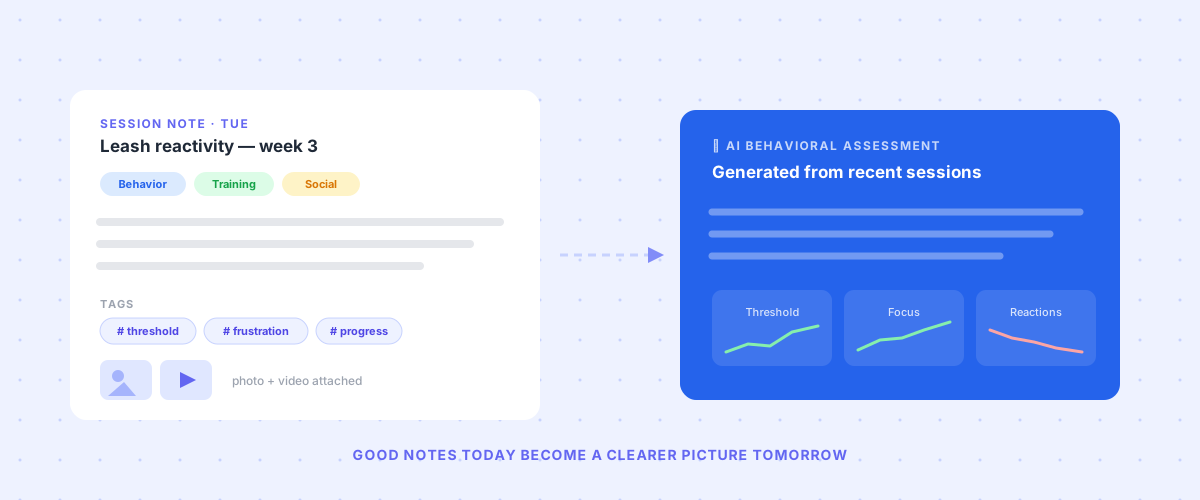
It also makes summarizing far easier. When the underlying notes are structured and tagged, pulling together an overview of how a dog is doing, for the owner, for a vet, or for a handoff, is a matter of reading a clear record rather than trawling your memory. HeelYeah! can generate a behavioral assessment from a dog's recent sessions and tags, which only works because the notes underneath it were captured with structure in the first place. Good input, useful output.
A short checklist
After each session, the notes worth having usually answer:
- What did we work on, and what was the actual result? Specific criteria, not "good progress."
- What changed from last time? Better, worse, or held, and under what conditions.
- Anything to flag? A medical note, a new trigger, something the owner should watch.
- What is next? One line so the next session starts without a warm-up guess.
Four answers, captured while it is fresh, filed by type, and tagged where a pattern is worth tracking. That is the whole discipline, and it pays back every time you open a dog's history and find exactly what you needed.
From a trainer using HeelYeah!
"What I appreciate most is that it’s clearly designed with both trainers and clients in mind. The features address the day-to-day needs of running a training business while creating a smooth experience for clients."