Dog Training Lead Management: The Inquiry You Meant to Answer on Tuesday
A message comes in at ten past nine on a Saturday morning. "Hi! I saw your page. I have a two year old shepherd who lunges at every dog we pass on a walk. Do you work with that, and what do you charge?" You are three minutes from a client's driveway, so you read it, decide it deserves a proper answer rather than a rushed one, and put the phone down.
You think about it twice that day. Once between sessions, once while unloading the car. Sunday is your one day off. Monday runs long. On Tuesday evening you finally sit down and write the good reply, the one that explains why you would want to see the dog before quoting anything, and she writes back, politely, that she has already booked a consult with someone else for Thursday.
She did not choose a better trainer. There was nothing in your answer for her to disagree with, because she never read it. She chose the trainer who answered on Saturday.
The inquiry is not lost to a competitor, it is lost to a Tuesday
Almost nobody loses this one on quality. It goes on timing, and on the fact that a training business does not have an inbox. It has five.
Inquiries arrive as an Instagram DM, a Facebook message, a contact form that lands in an email account you open on your laptop, a text to the number on your van, and a voicemail. None of those five is a list. Whether a given person gets a reply depends on which one they happened to use, and on what your week looked like when they used it.
That is not a discipline problem, and no amount of trying harder fixes it. You cannot work a list that does not exist. What you need is one place where every inquiry lands, in the order it arrived, with a state next to it.
An inquiry is not a client, and filing it as one makes its own mess
Trainers who do try to keep track usually do it by creating a client record for whoever asked. That works for about a month.
Then your client list is two hundred names, forty of which are people who asked one question in March and were never heard from again. Your reports count them. Your client total stops meaning anything. Anything you send to "all clients" goes to people who never hired you. And the households you are actually training get harder to find, because they are buried in a list that is mostly noise.
Someone who asked a question is a different kind of record from someone whose dog you see every Tuesday. Different fields, different screen, and above all a different ending: an inquiry either becomes a client or it goes quiet, and both are perfectly normal outcomes. Clients do not work that way, which is why the two should not share a list.
You already have a sales process, it just is not written down
Ask a trainer how they sell and most will say they do not, really. Then watch a month of it, and it is the same five steps every time. An inquiry comes in. You reply. You get the dog's history on a phone call. You propose a program and a price. They book, or they do not.
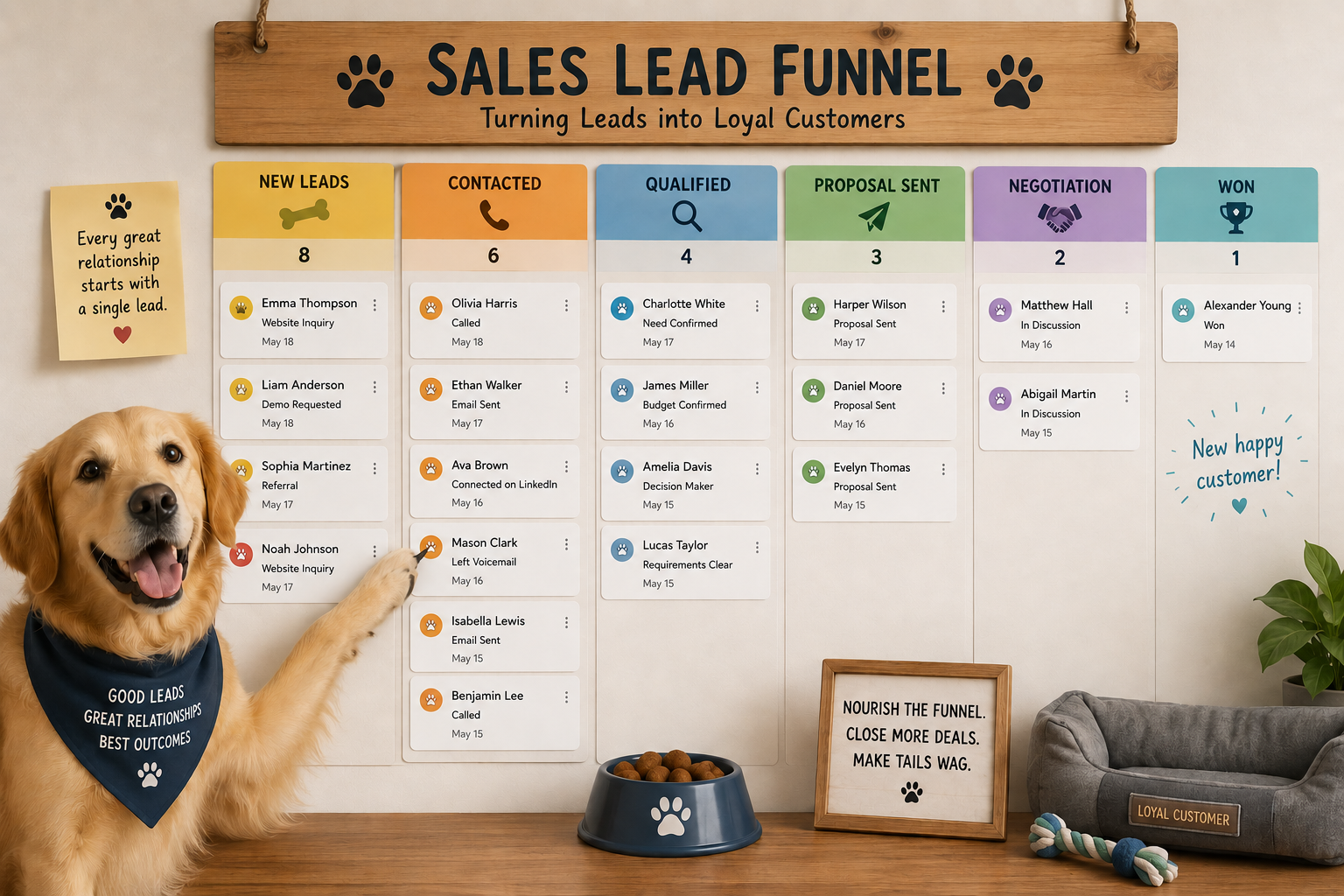
That is a pipeline, and naming the stages costs nothing while changing what you can see. New inquiry, contacted, consult booked, quote sent, won, lost. Every person who has ever asked about your training now sits in exactly one column, and the shape of the board tells you something a full calendar never will. Eleven people parked at "contacted" and two at "quote sent" means your problem is the phone call, not your prices.
The stages have to be yours. A trainer who only sells board and train after an in-person evaluation has a different funnel from one who sells six packs off a fifteen minute call. If the columns do not match the way you actually sell, you will stop moving cards within a fortnight, and a pipeline nobody updates is worse than no pipeline at all.
The follow-up is where the money is, and it is the part nobody does
Most inquiries that turn into clients do not turn on the first exchange. Somebody asks in April, when the dog is still manageable, and hires in June, when it is not. Somebody gets the price, needs to talk to their partner about it, and fully intends to come back.
What loses those is not a lack of interest on either side. It is that nothing anywhere ever raises its hand. The lead sits at "contacted" and quietly ages, and no spreadsheet has ever reminded anybody of anything.
Most inquiries are not lost at the price. They are lost in the four days between the question and the answer.
One nudge solves most of it. A reminder that this lead has been quiet for a week, sent to the person who actually spoke to them, turns circling back into a two minute job on a Tuesday morning instead of something you remember in the shower on Thursday. It is the same habit as following up after a program ends, pointed at the other end of the relationship.
Write down the conversation, not just the phone number
What makes a second call work is never the contact details. It is knowing that the dog is a two year old shepherd called Ollie, that the lunging started after a bad encounter at eight months, that they have already tried a prong collar and a group class that went badly, and that the husband is the one who is nervous about all of it.
Log that against the lead while you are still on the phone, and two things follow. The next conversation opens with the dog's name instead of "remind me what we discussed", which is most of the sale right there. And on the day they say yes, you are already holding everything you need to set them up properly.
Saying yes should not mean typing it all again
Here is the small indignity waiting at the end of a good sales process. The client commits, and your reward is fifteen minutes of data entry: the name, the email, the phone number, then the dog's name, breed and age, all retyped into a fresh client record from notes you took two weeks earlier.
It should be one action. The lead becomes a client, the owner's details become the client profile, and the dog you have been discussing since Saturday becomes a pet profile with the breed and the behavior concerns already on it. Then you are into the part you are good at, which is booking the first session, sending the paperwork, and taking a deposit or setting up a payment plan.
Let your website take the first step
The last piece is the one that stops the Saturday problem from ever starting. Put a capture form on your own site so an interested owner fills in their dog's details at the moment they are most motivated, rather than composing a message into the void and then waiting to find out if anyone reads it.
Two things then have to happen immediately, and neither of them should involve you. The prospect gets a confirmation back within seconds, which is the whole difference between "did that even go through?" and "these people are on it". And the lead lands in your pipeline, with an email to you and to whoever else on your team should see it, so a Saturday inquiry is on the list before you have read a word of it.
From a trainer using HeelYeah
“HeelYeah has made it so much easier to keep every part of my dog training business organized in one place. From client and pet information to paperwork, scheduling, and payments, everything is easy to find and manage.”
None of this turns you into a salesperson, and it should not have to. The trainer who gets the shepherd is not running a slicker operation than you are. They answered, they wrote down what was said, and they came back a week later when they did not hear anything.
Get every inquiry into one list. Give it a stage. Write down the conversation. Be told when one goes quiet. The people asking about your training are already interested, and most of the work is simply not losing them between the question and the answer.