How to Get Dog Training Clients to Practice Between Sessions
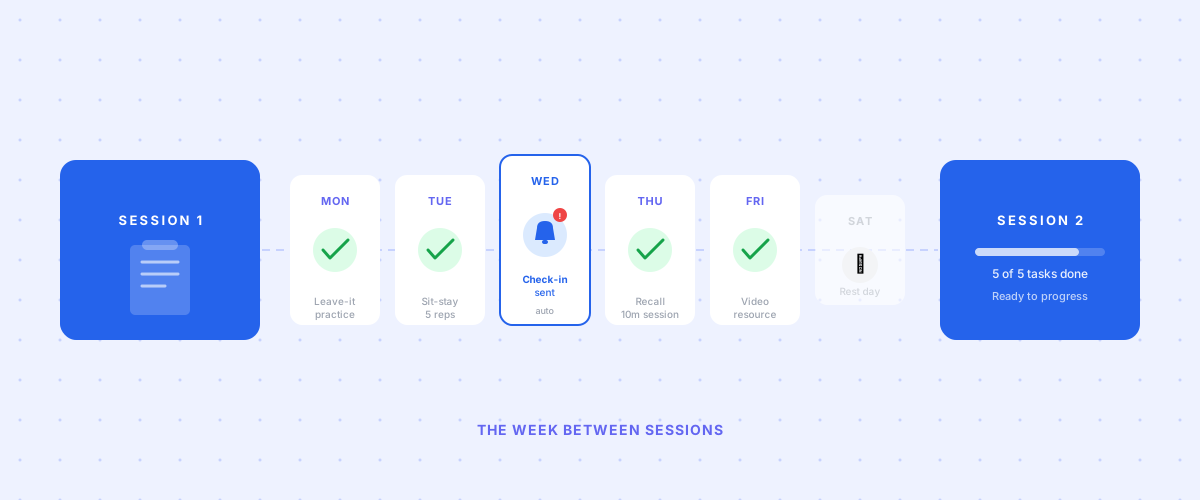
The session goes well. The dog gets it. The owner gets it. You leave feeling good about the work. Then they come back two weeks later and you might as well be starting over.
This is one of the most consistent frustrations trainers talk about, regardless of method, price point, or clientele. The training itself is not the problem. The gap between sessions is.
What happens in that gap determines whether training sticks or fades. And most of the time, it is not that clients do not care. It is that nothing is keeping them connected to the work.
Why clients stop practicing (even when they mean to)
Most clients leave a session genuinely intending to practice. The motivation is real in the moment. But over the following days, it competes with everything else in their life, and without any structure to support it, training slides to the bottom of the list.
Three things usually cause the gap:
- They forgot what to do. Without a written summary or specific assignment, "practice the recall" is easy to defer. There is nothing concrete to check off.
- They were not sure how to do it on their own. A lot of clients give up quietly because they are not confident they are doing it right. They do not want to do it wrong, so they do not do it at all.
- Nobody followed up. If the next contact is the following session, there is no natural moment to restart if they have fallen off. By the time you see them again, a week or two has passed.
All three of these are fixable. They are structural problems, not character problems.
Make the homework specific
Vague encouragement does not work. "Practice the sit" is not a task. It has no due date, no success criteria, and no natural moment where the client thinks "I need to do this now."
Specific homework looks different. Instead of "work on impulse control," it is: "Before dinner each night this week, do five repetitions of leave-it at low distraction. Stop if your dog is getting frustrated." That is something a client can actually do, check off, and feel good about completing.
A due date helps too. "By Thursday" gives the practice a deadline, which is when most people do things.
Give them what they need to do it without you
Clients who understand the reasoning behind a skill are more likely to practice it. And clients who have a resource to refer back to, like a video of the technique or a short written description, are more likely to do it correctly when they are on their own.
This does not need to be elaborate. A one-minute video of the skill being done right, or a brief written description of the mechanics, is often enough. The goal is to remove the "I am not sure I am doing this right" excuse, because that excuse is genuinely stopping people.
Attaching resources directly to the homework task is more effective than sending them separately. If the task and the resource arrive together, the client does not have to go looking for anything. Everything they need is in one place.
Follow up before the next session, not at it
Waiting until the next appointment to find out how practice went is too late to course-correct. If a client fell off after day two, by the time you see them again, the window to restart has already closed.
A check-in three to five days after a session catches clients at the moment they have most likely drifted. At that point, a short message ("how did the leave-it work go this week?") can restart them. It also signals that the practice matters, not just the session.
The follow-up does not have to come from you personally every time. An automated check-in, triggered when a task has not been marked complete by a certain point, can do the same work without adding to your plate.
Make it easy to ask a quick question
A lot of clients give up because they hit a snag and do not want to bother you with it. They tried the exercise, it did not go the way it did in the session, and now they are not sure what to do. So they stop.
An accessible, low-friction way to send a quick message removes this barrier. It does not mean being available around the clock. It means clients know there is a place to drop a question when they need one, and that it will not go into a void.
The trainers who handle between-session practice best are not doing anything exotic. They have a system: homework goes to the client right after the session, with the resources attached. A check-in happens automatically if the task stays incomplete. The client has a portal where all of it lives. None of this depends on the trainer remembering to do it manually every time.
What this looks like in practice
A few things that trainers have found useful:
- Send the summary the same day, not a few days later. The sooner after the session the client gets their homework, the more connected it feels to what just happened.
- Keep the task list short. Two or three specific things is better than eight. A short list gets done. A long list gets avoided.
- Stagger the due dates. If you assign three tasks, give them different timelines. Task one due in three days, task two due in a week. It builds momentum instead of front-loading everything.
- Acknowledge when they do it. A short reply when a client marks something complete goes a long way. It confirms they are doing it right and makes them more likely to keep going.
The gap is where it all happens
Between sessions is where training either takes hold or fades. Most of the time, the difference is not the quality of the session itself. It is whether the client has clear homework, the resources to do it, and some form of accountability in between.
None of this requires a lot of extra work from you. It requires a bit of structure applied consistently, and a way to deliver it that does not eat into your time every single week.
From a trainer using HeelYeah!
"What I appreciate most is that it’s clearly designed with both trainers and clients in mind. The features address the day-to-day needs of running a training business while creating a smooth experience for clients."